topics
Showing posts with label Catholic homeschooling. Show all posts
Thursday, March 1, 2018
Multum Non Multa--Just Follow the Books
Today I'm thinking, once again, about that Latin phrase, multum non multa. This translates as "much not many" and embraces English maxims such as "quality over quantity" and "less is more." Multum non multa encourages us to choose depth over breadth and is aptly applied to education. I think that minimalist homeschooling is a reflection of this classical principle. We can think of it in terms of simplicity.
In my "Catholic Vintage & Minimalist Homeschoolers" Facebook group (https://www.facebook.com/groups/914254035384695/), a member surprised me with the comment that her homeschooling was going so much more smoothly simply as a result of using Catholic Heritage Curricula (CHC). To her, this was homeschooling minimalism.
An open-and-go curriculum like CHC is often billed as good for newbies who need to have their hands held. Once one is a seasoned homeschooler, however, it's expected in many circles that you design your own curriculum and/or follow a more "real" method of learning, such as Charlotte Mason, unschooling, or classical. Traditional programs which use a text/workbook type format are considered school-at-home and are met with a derisive attitude. But let's take a closer look.
Are you necessarily doing school-at-home if you use a traditional program?
First of all, a traditional Christian homeschool curriculum will not duplicate the type of content and methodology being utilized in the secular humanist U.S. public schools, with the cradle-to-grave indoctrination agenda known as Common Core. If you're using a Catholic program like Seton Home Study or CHC, the Faith, rather than a politically liberal, consumerist scheme, permeates the curriculum. Both of these educational providers emphasize personalizing the plan according to the needs of the individual child. You can use as many or as little of the resources as you would like. Even if you have a large family, you can provide ample one-on-one tutoring and small group lessons, which simply isn't possible in today's large classrooms. I think it's safe to assume that most of you are not standing at a chalkboard giving lectures.
There are many more distinctions that we could make, but I think the point is clear that homeschooling, whatever the curricula and methods used, is a far cry from the typical school experience. Learning involves the totality of family and community life and is not limited to school books. Also, using a traditional program need not mean a cookie-cutter approach.
Is a traditional curriculum less "real"?
You will hear the argument from some homeschoolers that a traditional Catholic program is not really traditional; that it follows certain changes made away from the earlier classical model, which occurred in the public schools in response to the Industrial Revolution. Catholic schools then adopted the new progressive approach. I think there is a certain amount of truth to this position. Yet, it's also true that in providing an education to all people, not just the elites, and in accordance with changes in the societal structure and the growth of the middle class, there was wisdom in broadening the methods used to teach a more diverse body of students. We know as home educators that one way does not suit all. And if we reflect on Catholic schools in the 1950s, before the secularization that followed in subsequent decades, we see that the Faith permeated every subject, and that students were well-educated both in terms of religion and academics.
Traditional programs such as CHC and Seton have retained the classical philosophy in a truly Catholic sense--following the scholasticism of St. Thomas Aquinas. Living books and hands-on activities are incorporated into such programs, along with classical features including memory work, copy work, dictation, classic literature, Latin and other foreign languages, journaling and essay writing. These curriculum providers and others like them also use reprints of vintage Catholic school books. I think of programs like these as presenting a classical-traditional, liberal arts education--what I like to call, Vintage Catholic Homeschooling. That's real to me!
So let's all let go of this argument, once and forever, over what is real, classical, traditional, etc., and be about the business of living our homeschooling lifestyle to the fullest, rather than dwelling on some perfectionistic ideal. Let's keep the focus on helping our children to become the unique persons that God has created them to be.
The multum non multa path I'm on right now is to simply follow the books.
I've spent way too much time trying to conform to a particular pedagogy and attempting to cover all-the-things. (I'm looking at you, Charlotte Mason!) I've discovered that as my child has entered the teen years, being a seasoned homeschooler is now about focusing on those areas that need the most attention before we hit high school (Mother of God, pray for us!) and going more deeply into them. I've chosen quality books from Seton and CHC, as well as other resources that reflect the Good, the True, and the Beautiful, and I'm trusting what they present. I'm doing things by the book, if you will, rather than trying to reinvent the wheel.
That doesn't mean that there's anything wrong with designing your own curriculum. In fact, I still do! I simply rely more upon those resources that take the guess work out of the process; and which present the Catholic worldview along with the ideas and skills that make for a well-rounded education. I have pared down the books for each term, and I resist the temptation to supplement the curriculum.
Let enough be enough.
My plan is to set my schedule (see the previous post), sticking to it for the duration of the term, and let the books do most of the work. My job is to be diligent and to facilitate the learning process as my child becomes more independent. Choose good books and follow the course, just like Dorothy and her yellow brick road, and you will arrive right where you need to be.
Sunday, February 25, 2018
February Freak-out & Vintage Catholic Homeschool Schedule (Winter 2018 Term)
Our Lady of Sorrows
In the past I've heard that February is the most difficult month of all for homeschool teachers; yet I don't think I've really experienced this myself. Until last Thursday. First, the dogs started barking as soon as we had begun our lesson time. Then my beloved daughter Beezy's attitude about going over the vocabulary for the chapter she was about to read was the opposite of enthusiastic. I had a meltdown, and not just one that day.
Since becoming Catholic, I don't think I've ever gone through Lent without some sort of tragedy or personal crisis occurring. This year, right on Ash Wednesday (also Valentine's Day) there was yet another horrific school shooting, this time in Florida, leaving 17 people dead. Following the news surrounding this event has left me with frayed nerves and a broken heart, as I'm sure it has most everyone else. Maybe another contributing factor to my explosiveness is the detoxifying process of giving up coffee and dairy. We've seen very little of the sun lately. None of that is any excuse for being unkind and severely critical toward my child, and I'm having a hard time forgiving myself.
My saving grace is that I know that God works all things for our ultimate good, and he is helping me to see the areas where my family needs to grow and function better together. And today this idea of February being "homeschool burnout month" crossed my mind. By this time of the school year, we have been working hard for many months, and we still have a few months left before we can take a long, much needed break. Perhaps we haven't progressed as far as we had planned, and we're beginning to panic about reaching our goals and finishing the year in good stead.
I think that this month is also the time that many of us begin to look ahead to next year--and the state of feeling overwhelmed sets in. For me, the upcoming year is 8th grade, which is the prep year for high school. With that thought, I am no longer in the present moment. I'm no longer resting in His presence. I'm already feeling frantic, trying to plan all four year of high school in my mind.
We can only live one day at a time, my friends. Yes, we want to be prepared for the future. But we can only be prepared for tomorrow by focusing diligently on our work for today.
Since I decided to take a minimalist approach to homeschooling, I've felt relieved of much of the pressure that trying to present the ideal Charlotte Mason education had put on me. Yet I still don't feel like we've been able to make enough progress with those subjects that I deemed as top priorities. I think this has to do with the fact that I stopped following a set schedule. Things seemed to be humming along fine, with simply moving from one book to another in our ancient history unit studies. After much prayer over the last few days since my freak-out, I've decided to get back to a weekly schedule and having the satisfaction of checking items off the list.
There are three subjects to be done daily, four days a week--math, cursive writing, and piano practice. The subjects listed under alternate (the verb) are put into pairs. One item of each pair will be done a day. In other words, the subjects in a pair will be alternated every other day. For example, Bible History will be done on Monday and Wednesday, and Cleopatra of Egypt will be covered Tuesday and Thursday. There are a total of 6 alternating subjects. So 6 subjects are covered each day, with a total of nine for the week. The weekly category is composed of activities outside the home.
We are technically working on the ancient Greece unit, but as I've written before, the Cleopatra novel encompasses the entire region of Egypt, Greece, and Rome. In world history, we are covering the chapters on Greece. When finished, Beezy will choose another art project from Draw and Write through History. Most likely it will be the drawing of Alexander the Great's horse! I would like to get back to the nature study book we used in the fall for the upcoming spring term, but for now, here is the schedule:
Vintage Catholic Homeschool Schedule, 2017–2018
Term
2, Ancient History Unit Studies (Greece)
Daily:
-
Saxon Math
-
Piano Practice
-
Cursive Writing (Seton)
Alternate:
-
Bible History (Seton)
-
Cleopatra of Egypt (Hornblow)
-
CHC Grammar & Composition
-
Intermediate Language Lessons (Serl)
-
World History (Seton)
-
Religion (Seton)
Weekly:
- Religious Education Class
- Piano Lesson
- Co-op Choir & Musical
Theater (Mary Poppins)Please let me know if you have any questions. For inspiration to get you through this tough time, here's a link to a blog post that inspired me today: http://jessconnell.com/did-you-know-february-is-homeschool-burnout-month/
Sunday, December 17, 2017
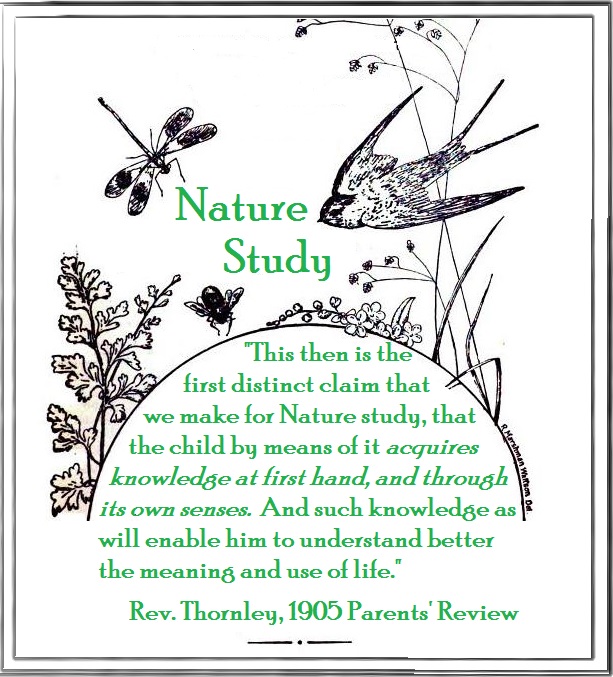
Nature Study: The Basis of All Science
Happy 3rd Sunday of Advent! I wasn't going to blog on Sundays, as this is the day of rest; but for me, contemplation is restful. I was stunned to see that I haven't written a new post in almost a month. This is because I have been pondering many things and have been busy preparing for Christmas and enjoying Advent festivities. Last night at dinner, this repose of the soul enabled me to gain a valuable insight.
My daughter's friend was visiting, and she lamented that although she was looking forward to her Christmas break from school, she was dreading the science exams that will precede it. She's an 8th grader who is in an advanced science class. This prompted my husband to comment that he was advanced in science in high school. He recalled timed chemistry lab tests. I was surprised to find myself quiet throughout the conversation, and I observed that my mind was fixed upon the phrase Nature Study.
Today I asked our guest more about her class, which is high school level. She described it as physical science but couldn't tell me what that meant. What topics were covered under that heading? All she could relay was that she had learned about energy.
The only really excellent science class I experienced in public school was in the 6th grade. A couple of years ago I had the opportunity to tell the teacher, Miss Snyder, how much I appreciated her class. I explained that I remembered her class, that it made a lasting impression. (And I'm almost 49, peeps!) She brought science alive. It was hands-on, and guess what? We did Nature studies!
I made a leaf collection, relying upon my grandma's knowledge of natural history and her field guides. I caught some insects and drowned them in alcohol (in hindsight, yikes!), pinned them to a board, then researched and labeled them. I had to be outside, observing God's natural world, to complete these projects. I obtained some intimate knowledge of plants and creatures, especially because I lived in the country.
I'm extremely grateful that as a child and teenager I had many opportunities to explore fields, woods, lakes, ponds, and creeks. My love of Nature has endured. In fact, I think one motivator for moving away from the city and back to my hometown was the lure of the quiet rural environment and proximity to the memories of my idyllic childhood wandering in the woods and hopping on stones across water. Yet even with these advantages, I realized as an adult that I really had not obtained a strong foundation in natural science.
If I had any science education in Jr. High, I don't remember it. I enjoyed learning the names of bones in high school, and I loved Moe's scale of hardness. I was extremely fond of the Periodic Table of the Elements, though chemistry alluded me almost entirely. Newton's laws of motion I found to be extremely intriguing. I did not like dissection and couldn't tell one internal organ from another, largely because the formaldehyde the frogs were soaked in caused everything to be the same color.
Way back in the 1980s, God was still allowed a presence in schools. In one class in high school, probably geology or biology, the teacher showed us a Creation vs. Evolution film. His comment afterward, which surprised me quite a bit, was that he thought it took more faith to believe in evolution than in creation. This was the opinion of a man of science, and I never forgot what he said. Today, such movies would not be shown, and such comments would likely put teachers at risk of being fired.
Before kids are introduced to advanced science, they should have many years of time spent intimately with Nature. They should be familiar with local trees, landscape features, animals, flowers and habitats; should know them by name. They ought to be able to distinguish the calls of neighborhood birds and the habits of many creatures. Direct observation, living books and nature journaling should take precedence, with textbooks and lab work taking a secondary role of reinforcement of key concepts. Nature Study is the basis of all science, and without such a background, advanced science classes are almost pointless. Most of all, the child should care about the world around him.
Though I don't enjoy the cold, I understand the importance of getting outside in winter, even for a short time, every day. I'm re-committed to a Charlotte Mason approach to natural science, which, by the way, is in harmony with Catholic tradition. The combination of nature deprivation and excessive screen time has lead us increasingly to being a nation of depressed, isolated, and unhealthy people, and children are the greatest victims. We are disconnected from one another, from the natural environment, and as it follows, from knowledge of God himself as a result. I would go so far as to say that we are losing our grip on reality and the wisdom of what it means to be human. It's time to reunite science with a sense of the awesome and the Divine.
Monday, November 6, 2017
Ancient History Studies Update
It's hard to believe we are already into the first week of November! I want to update readers on the progress of my history-based unit studies plans. Since my last post, I've found a great blog focused on minimalist homeschooling, "Zara, PhD" (http://www.zaraphd.com/2017/08/01/what-is-minimalist-homeschooling/). The linked post begins a series on implementing a minimalist homeschooling mindset. I have also ordered Zara's book, Minimalist Homeschooling, from Amazon, and I'm sure I'll be reflecting a great deal on her wisdom. It just so happens that Zara is Catholic, so that's a bonus!
I've continued to work on paring down the curriculum during this fall term and to create a schedule that is set and easy to follow. It has been difficult to release the Charlotte Mason mindset regarding spreading a huge feast of books and subjects. My goal was to have only a daily list of subjects, but I ended up reverting to including a loop of additional subjects. Not only that, but I was doubling up on some of the daily subjects as well! I was perpetually clogging my mind with worry about how I could juggle it all. I finally tossed Spanish out of the curriculum for now. I know, incredulous gasp! But baby steps to minimalism it must be.
I plan to get back to the Spanish, but first I need to sort out our priority subjects and focus on them. First things first. Zara, PhD is going to hold my hand through this, but I've already made a start. Basically, the top 3 subjects that are most important at this time are math, writing, and literature. Now, integrating subjects is a great way to go about simplifying things. Tomorrow we'll be finished with Seton's Bible History: Old Testament book. That one book incorporated reading, religion, and history. But we haven't worked in Seton's Religion book for awhile, which is the formal catechism we are using this year, continuing from last year. At this rate, we'll be in this book forever!
You will hear folks in homeschooling circles admonish that finishing a book and checking items off a list does not constitute learning. That may be true, but if you spread your efforts across too many books and subjects, the learning will be thin. It's a good thing to spend enough quality time with a book, to go deeply into the subject--and it's a good thing to finish the book. Dragging books out due to lack of consistency is self-defeating. The priority subjects will constitute our daily core, and then subjects of secondary importance (but still key to our unit studies) will be looped. The Catholic Faith permeates the curriculum, but especially as this is Beezy's sacrament of Confirmation year, I don't want to neglect religion as its own subject.
Beezy is still working on her Hanging Gardens of Babylon art project, from Draw and Write Through History. I think she'll finish it this week. So the Old Testament unit will be wrapped up this week, culminating with a study guide I designed and a test. Then next week we'll move on to ancient Egypt!
Our reading/history book will be Cleopatra of Egypt by Leonora Hornblow (Landmark Books). The brilliant aspect with this book is that Cleopatra's world covers the entire territory for our ancient history studies--Egypt, Greece, Rome, and the Bible Lands!
I decided to make writing very simple. In addition to cursive writing, Beezy will have one other writing assignment per day. This can include dictation lessons, written narrations, answering chapter questions, poetry or other creative writing, letters to grandparents, personal journaling, etc... I found a Writer's Express handbook at our homeschool co-op to use as a guide for different types of writing.
We're using Saxon Math now, and it's such a relief to have a solid program to follow. I no longer have anxiety about teaching math! We will use this program all the way through high school, as far as Beezy is able to go into the higher math subjects.
I'll just leave you with the schedule I have planned for the remainder of this term (until Christmas break). Daily subjects are math, literature/history, piano practice, and English. The loop includes art, religion, geography, and science/health. These subjects will be rotated throughout the week, or each may get a few days or more at a time, depending on the need. This works out to 5 subjects covered daily, for a 4-day week.
Remember that life itself and extracurricular activities can take care of some of the subjects. Every subject does not need to be covered every day, every term. When you look at my entire schedule, all of the required school subjects are covered (according to the requirements of my state). It is minimalist and simple, yet we have attained the variety and depth characteristic of a liberal arts curriculum.
Daily Core: (Open with Pure Faith: A Prayer Book for Teens)
- Saxon Math
- Literature/History: Cleopatra of Egypt
- Piano practice
- English (cursive, grammar, writing skills)
Loop:
- Religion
- Science/Health
- Art
- Geography
Extracurriculars:
- Piano lessons
- Tumbling class
- Religious Ed. class
- Choir and Musical Theater co-op classes
Monday, August 28, 2017
Toward a Catholic Philosophy of Education
While doing some housekeeping chores today, I turned on Catholic Radio and happily encountered a discussion on Catholic education. Unfortunately I missed some of it, but I was able to tune into large portions of the show over the hour. I didn't catch the name of the man being interviewed, but he was someone in charge of the St. Augustine homeschooling enrichment program in the Toledo, Ohio area.
He said something that amazed me: The Mass is the center of a Catholic liberal arts education. I'd never heard it put this way before. Homeschoolers who take their children to daily Mass are on the right track!
This program guest discussed the need for Catholic schools to return to a classical method of education. In one sense, he said, the purpose of classical education is the cultivation of virtue, the idea of how to live fully as a human being. He listed philosophy, theology, history, literature, mathematics, and the sciences as traditional liberal arts subjects. I think foreign language study was also included. I may be leaving something out, but that's what I remember. What we are talking about is the pursuit of Truth, Goodness, and Beauty for their own sake.
He explained that some people think that Socratic dialogue is classical education; but what that really entailed was Socrates talking at great length and then his listeners either agreeing or disagreeing with him! A liberal arts education more accurately draws the learner out with questions on the material, and subsequent discussions develop from them.
I have mentioned this point in previous posts as being at odds with Charlotte Mason, who did not believe in putting questions to the child. To be sure, we do not want to take on a quizzing attitude, but I think we do need to incorporate a few well-chosen questions now and again, while focusing on the conversational aspect. This would be a very Thomas Aquinas style approach.
I personally prefer the term "liberal arts" to "classical", simply because it encompasses a broader definition than the exclusively Trivium-focused or Latin-centered styles in vogue today. And I believe that a liberal arts education can be achieved whether one uses a traditional curriculum package, such as Seton Home Study; a guide to books and lesson plans which implements classical teaching techniques, such as Mother of Divine Grace; or a self-designed course of study such as that outlined in Elizabeth Foss's Real Learning. Catholic Heritage Curricula incorporates both "traditional" and "classical" education methods and is Charlotte Mason friendly.
The fine arts were also mentioned in the radio program as those pursuits which bring the joy of being human into our lives.
I find it very telling regarding the dubious course of modern American education, that entire majors in the humanities, such as philosophy, are being removed from universities, and others, such as English, are being drastically reduced. This is most likely in response to the Common Core Curriculum standards which are dumbing down education in America's schools. While technological and trade skills are immensely advantageous in finding a good job, as Charlotte Mason stressed, a liberal arts education should be the foundation for making one the best person possible, no matter what field one enters.
From what I've been able to discern from extensive reading on the subject over the summer, and what the radio show helped to click into place, an authentically Catholic education could be summed up with three basic principles:
1. Parents are the primary and principle educators of their children.
2. The Catholic Faith must permeate the entire curriculum via an organized, liberal arts framework, serving to educate the whole person.
3. A broad and general sense of what we need to know as human beings is transferred in a shared body of knowledge and wisdom, both in terms of what we can understand via human reason and what we learn from divine revelation.
These principles could be elaborated upon, but I think that is the crux of the matter. They explain what is meant by scholasticism, the marriage of faith and reason which characterizes a classic Catholic education. I have to agree with Charlotte Mason in that the course of study should not be directed by the child's interests, though plenty of time is left in the day to explore those. I think in this respect, CM's philosophy is perfectly in line with Catholic teaching. Naturally, as the Church teaches, children will be allowed a gradual increase in independence and decision-making as they mature.
Last night I was listening to a podcast on youtube featuring Dr. Mary Hood on the topic of relaxed homeschooling. She put the obtaining of knowledge at the bottom of her educational goals. This would not be in line with a liberal arts education, and Charlotte Mason would certainly disagree with Dr. Hood. Charlotte believed that a broad and generous curriculum of knowledge was the very thing children needed to feed their minds and souls. They should be educated on the ideas of the best minds, chiefly through living books, but also by way of direct experiences and observations.
What Mary Hood and Miss Mason would likely agree upon is the necessity of cultivating communication skills. Dr. Hood stated these as reading, writing, listening, and speaking skills. All of these are fostered in a liberal arts education.
Can textbooks fit into this liberal arts picture? I think a combination of classical methods, using original sources and living books, along with some judiciously chosen, traditional text/workbooks is ideal. It helps to have a framework around which to build the course of study, especially if one wishes to base it upon historical periods. As the historical worldview needs to be specifically Catholic according to the Church, a selection of Catholic history text/workbooks is exceedingly helpful to the busy homeschooling parent. However, each of us will find the best combination of resources for our homeschools. My idea is but one among many.
In the homeschool enrichment program that the man on the radio directs, children learn about four blocks of history in a four-year rotation; so children of different ages are learning through the same period of history, but at different levels. Children of multiple ages in the same family can then discuss the ideas and facts being learned together! This sounds a lot like the history-based unit studies approach I am implementing this year.
While you might have to dig a little harder to get a firm grasp on an authentic Catholic pedagogy, as opposed to the proliferation of material on various other homeschooling methods, the Church does provide us with the only philosophy we really need in her catechism and papal encyclicals on education, parenting, and family life. We have the stories of the Bible and the saints to guide us in virtue. We can utilize a few classical techniques and choose from a number of Catholic curriculum providers (and the library!) to help us achieve our goals for our children. We can tailor the education to the individual child and to our unique family situations.
Most of all we need confidence as Catholic homeschoolers that we are doing the very best thing for our children, and Holy Mother Church gives this to us. The best thing we can do is to know our Faith well and to study the teachings of the Church on education. An excellent overview is given on these teachings in Catholic Home Schooling by Mary Kay Clark, founder of Seton Home Study School.
What I'm hoping to accomplish with all this is to encourage Catholic home educators to let go of obsessing over philosophies and methods and to focus instead on being Catholic. "Liberal arts" does not have to become yet another label. If you are teaching and living the Faith with your children and providing them with a Catholic worldview in the curriculum, and giving them a broad and generous course of study oriented toward virtue, you can't really go wrong. And though it might seem counterintuitive, even a minimalist curriculum approach can thoroughly reflect the liberal and fine arts. But that's a topic for next time!!
Sunday, July 30, 2017
Old Testament/Victorian England Unit Study
Since Beezy's musical theater class with the homeschooling co-op will be putting on Mary Poppins, I felt inspired to create a Victorian England unit study. Yet I didn't want to disrupt the ancient history schedule I already had planned. (See the June 23 post, My Simplest Homeschooling Schedule Ever!)
The solution I came up with was to combine the Old Testament and Victorian England units! I did not have a literary novel chosen for the O.T. unit, so Beezy will be reading The Secret Garden by Frances Hodgson Burnett, which takes place in the Victorian Era. Chapter 80 of Hillyer's A Child's History of the World will introduce the time period, and other Victorian/Edwardian selections will be worked in. Beezy will still do the Hanging Gardens of Babylon art project from Draw and Write Through History, but instead of prehistoric art, she'll study Beatrix Potter. Nature studies will focus on the flora and fauna popular with the Victorians and featured in Potter's artwork. Our poet study is the lovely Alfred, Lord Tennyson.
I'll keep you posted as the unit develops. Cheerio!!
Vintage Catholic Daily Homeschool Schedule, 2017–2018
Term
1, Old Testament/Victorian England Unit Study
1.
Hamilton's Arithmetic/Total Math
2.
Piano Practice
3.
Bible History/A Child's Geography/Child's History of the World
(sub
in The Country Artist and The
Royal Diaries: Victoria)
4.
Spanish/Religion
5.
Language of God/Handwriting
6.
Nature Study: Some Animals & Their Homes/ABC's of Nature
7.
Art & Poetry: Hanging Gardens Project/The Art of Beatrix Potter
(sub in Pressed Flowers
Book Marks/Alfred, Lord Tennyson/Song of Songs)
8.
Free Reading: The Secret Garden
Weekly:
Religious Education Class
Horseback Riding Lessons
Homeschool Co-op Choir &
Musical Theater (Mary Poppins)
Labels:
Alfred Lord Tennyson,
Beatrix Potter,
Catholic homeschooling,
Draw and Write Through History,
Frances Hodgson Burnett,
Organic Mothering,
Queen Victoria,
The Secret Garden,
unit studies,
Victorian England
Friday, June 23, 2017
My Simplest Homeschool Schedule Ever!
A couple of days ago I got our homeschooling "approval" letter from the local school superintendent. The paperwork for our state is of course necessary, but the approval can't be denied as long as everything is in order. Still, it's nice to have the formalities completed and not to have any loose ends hanging over my head!
I've been doing a lot of journaling lately as part of my contemplative, devotional practice. I do believe that as I pray over our homeschool, the Holy Spirit guides me, especially by way of intuitive insights. One day a couple of weeks ago while I was writing, I made a list of subjects--handwriting, math, piano, reading, art, and Spanish. Can you imagine what Charlotte Mason would have thought about a mere six subjects?! I fleshed this out to seven daily subjects/books, based upon the unit studies I have planned. (Notice, there are no loop schedules!) I'll enumerate them first, and then explain how the system will work.
1. Bible History/Geography
(sub in Religion and Songs of Songs)
2. Hamilton's Arithmetic (supplemented with Total Math)
3. Cursive Writing (Seton)
4. Learn Spanish with Grace!
5. Language of God (CHC grammar)
6. Art Project/Nature Study
(sub in The Story of Painting/Prehistoric Art/The Feelings
Book)
7. Piano Practice
The first unit I've created for the upcoming fall term is based on the Old Testament. Since Beezy already read an Old Testament historical novel this past spring term, King David and His Songs (Windeatt), Seton's Bible History: Old Testament will serve as her primary reading text. I will be reading aloud the relevant chapters from A Child's Geography of the World (Hillyer), for which Beezy will write narrations. So the first "subject" is actually History/Geography, alternating twice each in a four-day week. (Fridays Beezy will have Choir and Musical Theater classes with a homeschooling co-op.)
We will finish the Geography chapters before the Bible History (which will cover King Solomon to the end of the book), so then Seton's Religion 6 for Young Catholics book will be subbed in (continued from this past school year), as well as passages from the Songs of Songs; incorporating copy work, dictation, and memory recitation. The Song of Songs is poetry, so you can see how more subjects are being worked in than initially meets the eye...
Art projects for this year will come from Draw and Write Through History, the first one being the Hanging Gardens of Babylon, one of the seven wonders of the ancient world. Art will alternate with Nature Study, for which we will be using Some Animals and Their Homes. When the art project is finished, we'll read the first section in The Story of Painting (Jansen, cave paintings), followed by Prehistoric Art (Hodges). From there we'll alternate between Some Animals and Their Homes and The Feelings Book from American Girl, which will be one of our Health topics.
Obviously this is not a "true" unit study, because all subjects are not related to the central theme of the Old Testament. The next topic, Ancient Egypt, will be more comprehensive. I think that this approach is going to be rich and varied enough in subjects/books, while keeping to a more multum non multa, classical philosophy. We will go more deeply into subjects, and the course of study will be more unified. And all of the books for the unit can fit into Beezy's workbox, including her composition and nature notebooks! I'm hoping to keep each unit to about six weeks.
In addition to the homeschooling co-op, Beezy will have weekly piano and horseback riding lessons, and tumbling classes.
So what do you think of my new, pared down schedule for the 7th grade? I can't wait to try it out, but for now we are all about summer!
Labels:
Ancient Egypt,
Catholic homeschooling,
Charlotte Mason,
classical education,
multum non multa,
Old Testament,
unit studies
Wednesday, June 14, 2017
The Good of Charlotte Mason
It may seem to readers that I've been very hard on Charlotte Mason lately. I felt the need to really pinpoint what the issues might be for Catholics, to be very aware of what elements don't mesh with the Faith and the Church's educational tradition. I do not mean to completely reject CM. After all, the Catholic Church is not opposed to new ideas. She does not insist upon any particular pedagogical method. It's entirely possible and permissible to take the Truth, Goodness, and Beauty found in non-Catholic resources. We simply need to be discerning.
I was reminded of the good of Charlotte Mason when I received a Stories of the Saints reading comprehension book that I had ordered from Catholic Heritage Curricula for the upcoming school year. For the first story, there are 12 vocabulary words to define and 10 comprehension questions. This seems like a lot to me. For Seton's Bible History chapters there are only about four, fill-in-the-blank questions to complete. I imagine that Beezy would blanch at the idea of doing so much more work!
However, she does need to be doing more writing, and answering all those questions with complete sentences would give her that opportunity. At the same time, because of CM, I know about alternative language arts methods. I can have Beezy do copy work and dictation lessons from the text. I could have her simply write a narration, and in fact the Stories of the Saints book suggests topics for essays. I could have her give me an oral narration after the story, and then she could answer only those questions that she did not already cover. With the vocabulary, she would only have to look up those words that she didn't already know. In the introduction, the author suggests several options for how the book might be used. In any case we are not locked in to only one way of doing things. That is the mentality I really want to get away from.
What I love about homeschooling is that we can try different things and do what works best. Even if I required Beezy to fill in every blank and answer every question, the work wouldn't have to be done all in one day. A number of different approaches and writing assignments can be used to encourage retention of the material and enhance thinking skills.
I think I simply needed to branch out with some new teaching ideas for the upcoming school year, to keep things fresh for both myself and my child. I've assimilated what I needed from Charlotte Mason and will probably have the occasional opportunity to revisit her. But I think that now, for the most part, we are on to new challenges and experiences. And we're just going to enjoy being the unique Catholic homeschooling family that we are!
Thursday, June 8, 2017
Reason and the Catholic Mind
Those who...honestly accept the final effect of the Reformation will none the less face the fact, that it was the Schoolman (Thomas Aquinas) who was the Reformer; and that the later Reformers were by comparison reactionaries... For instance, they riveted the mind back to the literal sufficiency of the Hebrew Scriptures; when St. Thomas had already spoken of the Spirit giving grace to the Greek philosophies. He insisted on the social duty of works; they only on the spiritual duty of faith. It was the very life of the Thomist teaching that Reason can be trusted: it was the very life of Lutheran teaching that Reason is utterly untrustworthy." --G.K. Chesterton (emphasis mine)
In the words of a popular 1990s song, Woop, there it is! I started reading Chesterton's St. Thomas Aquinas today, and already in the first chapter a fundamental difference between the Catholic and the Protestant mind is succinctly stated. And herein is further elucidation on the question of Charlotte Mason's appropriateness for Catholic educators.
Charlotte quite clearly did not trust in Reason, for the reason that the mind can logically defend any notion that it already believes to be true. In other words, we can easily fool ourselves. In this point I will agree. We can rationalize our way out of a nailed shut coffin. Today psychologists label rationalization as a defense mechanism used to justify bad behavior. It is a fallacy of reasoning, only superficially seeming to be logical. This is not a true use of the human faculty of Reason. But alas, Charlotte also disagreed with the training of the mind's faculties. She did not believe in the faculties of the mind at all.
This explains why CM discouraged Socratic questioning, why she wanted to leave the child free to come to his own conclusions. She seemed to believe that putting questions to the child's mind was encroaching upon his personality; and she argued that when given the ideas found in living books to feed his mind, he would not fail to come to the right conclusions on his own.
In the article recently discussed, "Thomas Aquinas and the Great Recognition," Art Middlekauff draws the distinction between Charlotte's educare, to nourish, and the classical educere, to draw out. Once again I must agree with Art. Charlotte was not a classical educator, in that her philosophy and method were not based upon the Greek and Latin studies of antiquity. He quotes her to prove his point:
Specialists, on the other hand, are apt to attach too much importance to the several exercise of the mental ‘faculties.’ We come across books on teaching, with lessons elaborately drawn up, in which certain work is assigned to the perceptive faculties, certain work to the imagination, to the judgment, and so on. Now this doctrine of the faculties, which rests on a false analogy between the mind and the body, is on its way to the limbo where the phrenologist’s ‘bumps’ now rest in peace. The mind would appear to be one and indivisible, and endowed with manifold powers; and this sort of doctoring of the material of knowledge is unnecessary for the healthy child, whose mind is capable of self-direction, and of applying itself to its proper work upon the parcel of knowledge delivered to it. Almost any subject which common sense points out as suitable for the instruction of children will afford exercise for all their powers, if properly presented. (emphasis mine)
I do in fact agree with Charlotte to a certain extent. This is why I'm not truly "classical" either. As I argued in the last post, I don't believe that Latin is absolutely necessary for training the mind in the faculty of Reason. I don't think her science on the brain is quite right, however. We do know that injury to a certain area of the brain can affect a particular function, such as memory, and that certain kinds of exercises can strengthen such functions. She is right that the brain is more complex than originally imagined and works as a whole, but we now know that all brains are not created equal. For example, the male brain is more compartmentalized; while the female brain is more complex, with a greater amount of connective tissue between the two hemispheres. No doubt we will continue to develop better understanding of brain science as time progresses.
I agree with Charlotte's emphasis on nourishing the mind on living ideas, as opposed to merely teaching a child how to learn, which seems to be the classical emphasis. I think that what Charlotte achieved was a nice balance in this respect. For example, memory recitation was a part of her method, but the curriculum wasn't centered upon rote memorization. It wasn't limited to, or even focused upon, the trivium of antiquity. There is no reason that children should have to wait until high school and college to obtain knowledge in a variety of subject areas, to have intimate acquaintance with many ideas and things. Both are right, both are necessary--educare and educere. And this is the Catholic Way, isn't it, the "both/and" frame of mind? I would have to argue with Art on this point: the Catholic Way is not "classical" as defined by his terms. It's scholastic.
Thomas Aquinas reconciled Aristotle to the Catholic Faith. Faith and Reason could live together in harmony; in fact, could not really live apart. Now, you may be wondering, why wasn't this point obvious to me before, that Charlotte Mason was simply not Catholic, and that of course there would be areas of disagreement. The thing is, I'm only now coming to understand why that matters. It's not just "Bible only" Christianity vs. Scripture and Tradition. It's Charlotte's philosophical rejection of Reason against St. Thomas' validation of Reason. Charlotte placed too much faith in the self-direction of the mind of the child, perhaps to the point of magical thinking; and hers is a Bible-only, educare-only philosophy. Training the Reason is the proper antidote to rationalization. And in a proper Catholic curriculum, the marriage of Faith and Reason is inherent.
Clearly we must be guided to developing our powers of Reason and the ability to come to the Truth. Vatican II put a primacy on the informed conscience of the faithful in decision making. It wasn't until college that I realized how bad I was at making decisions. Being presented with the most trivial of decisions (ie., a restaurant menu) would fluster me. If the conscience has not been properly formed, then the faithful will likely make decisions in opposition to the teachings of the Church. Hence we have Catholics and other Christians who support abortion rights, who live together before marriage, who believe in homosexual "marriage", etc.
Vatican II presupposed that Catholics would be raised with the proper development of their faculties of Reason! That they would know both what they believe and why, and would be able to defend the Faith. That they would be, with grace, safeguarded against rationalization. We see the results of watered-down catechesis and the failure to develop critical thinking skills all around us.
Charlotte Mason got part of the picture right, and to the extent that she was right, we can emulate her. But we have to be very aware of the ways in which her philosophy is diametrically opposed to Catholicism, and we have to choose the Church first. I would go so far as to say that the truths she "discovered" were already inherent in Catholic philosophy; and the more that we understand the Church's teachings on education and everything else, the less we Catholics will need to depend upon her.
Labels:
Catholic homeschooling,
Charlotte Mason,
classical education,
educare,
educere,
G.K. Chesterton,
informed conscience,
Organic Mothering,
Protestant Reformation,
Reason,
Scholasticism,
St. Thomas Aquinas
Friday, May 26, 2017
Charlotte Mason & the Catholic Conundrum, Part 2
The Triumph of Saint Thomas Aquinas
The fresco pictured here, "The Triumph of Saint Thomas Aquinas," is to be found in Florence, Italy, in the Spanish Chapel of the Basilica di Santa Maria Novella. Please see Art Middlekauff's article, "Thomas Aquinas and the Great Recognition," as our reference point for this discussion (http://charlottemasonpoetry.org/thomas-aquinas-and-the-great-recognition/).
Art tells us, "Thought to be executed by Andrea di Bonaiuto in the fourteenth century,
these frescos unabashedly delight in the great achievements of the
Domincan order."
"The Triumph of Saint Thomas Aquinas" is the fresco beloved by Charlotte Mason which I mentioned in Part 1, a copy of which she had in her House of Education and which she said formed her "educational creed."
Rather than paraphrase Art's entire article, I just want to sum up what I think are the issues in what he has brought out for the Catholic CM educator. First, Charlotte never once in all of her writings mentions the name of Thomas Aquinas. In chapter 25 of Parents and Children, she calls the fresco in question, "The Descent of the Holy Spirit." According to Art, she does at times call it Filosofica della Religione Cattolica (Philosophy of the Catholic Religion), but in chapter 25 there is no acknowledgement that this fresco has anything to do with St. Thomas, the Dominican order, or the Catholic Faith. This is despite the fact that Thomas is the central figure of the painting; that he is in fact larger than all of the other figures and is seated on a throne; and that it is intended to represent the supremacy of the teaching authority of the Catholic Church!
Further evidence of her intentional avoidance of St. Thomas is the way that CM discusses the Florentines, the "Florentine mind," and the Medieval scholastics in chapter 25. She attributes the ideas that she sees exemplified in the painting, which captures her notion of the "great recognition" in picture form, as seemingly flowering from the people of Florence in general, rather than from the tradition of the Catholic Church.
And what is this great recognition? It's the idea that the parents/teachers of children must recognize that the Holy Spirit is the supreme educator in all things, religious and secular, and that we must cooperate with the Spirit in order to effectively teach. There seems to be nothing "off" in this part of CM's philosophy. Yet she goes so far in chapter 25 as to suggest that a particular educational method might either "invite" or "repel" the Holy Spirit. The logic goes that since the Spirit is the giver of life, he would not cooperate with a teaching approach which is dry as dust, which is not living. The implication is that it is her method which will best invite the Spirit.
The Catholic Church adopted the educational philosophy and method of Thomas Aquinas, who is regarded as the Angelic Doctor of unparalleled esteem, not that of Charlotte Mason. The Holy Spirit does his work through Holy Mother Church. The education of our children is supposed to be based upon Catholic Faith Formation. Charlotte Mason interpreted the fresco to her own liking, but more problematic, she based her notion of the Holy Spirit's cooperation on her own interpretation of the Bible, and her philosophy follows suit.
Charlotte applied Jesus' saying, "Let the children be, and do not hinder them from coming to me, for of such is the kingdom of heaven," directly to her method. She tells us that we hinder the child by getting too much between him and the ideas found in living books. Let's consider narration, for example, a key CM method, which in itself is a practical tool for assimilating and remembering what is read. We are discouraged from having any influence on how the child's mind conceives of what he has taken in. We are to allow him to come to his own conclusions. Furthermore, the personality of the teacher should not have any play upon the child in his education. Her "charm" should be concealed, not used to any advantage. While St. Thomas would agree that discovery on one's own is the best way to learn anything, he also recognized that some things simply could not be learned without the guidance of the teacher, and that most people would have neither the time nor the courage to do so.
St. Thomas' method was distinguished by its conversational approach, presenting the material in engaging ways and leading the mind of the student to right thinking (the marriage of faith with reason). If we allow the books to be the primary educators of our children, then we are not following the Church's declaration that it is the parents who are the primary educators of their children! Yes, we do this with the guidance of the Holy Spirit. But Charlotte's notion that a method of education itself will either invite or repel the Spirit isn't Catholic. We invite the Holy Spirit through prayer. We receive the graces of the Spirit through the sacraments and life of the Church. And teaching is an art that we need to do well.
Charlotte's conception of the Spirit reminds me of the New Age "Universe," an impersonal energy that can be attracted (as in, the "law of attraction") and bent to one's will.
Some will say that none of this matters. That one can use CM's educational techniques, taking what one likes and leaving the rest. Homeschoolers subscribe to Charlotte's philosophy and method in varying ways and to greater and lesser degrees, so I certainly can't decree whether a Catholic can use her approach in good conscience or not. As I've written before, there can't be anything inherently heretical with using methods like copy work, narration, dictation, short lessons, and observational nature study.
At the same time, Charlotte herself insisted that simply using some of her teaching techniques was not enough, that we must indeed understand and apply the underlying philosophy. The method flows from the philosophy. If the philosophy is marked by serious error, then we do take a risk in employing the method.
It's ridiculous to imagine that the Holy Spirit might be repelled by, say, the use of textbooks and workbooks. This gets back to the over-emphasis on methods. What I think we need to do is to read what the Church has written on the education of youth. Remember that we are the primary educators of our children, and act accordingly. Provide them with a curriculum which presents a unified, Catholic worldview--a curriculum with faith formation at its core, which will serve in the formation of the Catholic mind.
You might take some aspects of the CM method to accomplish your goals. I think I have done this effectively in my own homeschool, but I also think that it could be done better, and without the potential baggage that CM might bring. Future posts will concentrate upon my findings.
Tuesday, May 23, 2017
Charlotte Mason & the Catholic Conundrum, Part 1
O Angelic Doctor St. Thomas, prince of theologians and model of philosophers, bright ornament of the Christian world and light of the Church; O heavenly patron of all Catholic schools, who didst learn wisdom without guile and dost communicate it without envy, intercede for us with the Son of God, Wisdom itself, that the spirit of wisdom may descend upon us, and enable us to understand clearly that which thou hast taught, and fulfill it by imitating thy deeds; to become partakers of that doctrine and virtue which caused thee to shine like the sun on earth; and at last to rejoice with thee forever in their most sweet fruits in heaven, together praising the Divine Wisdom for all eternity. Amen.
Here is today's question: What would happen if I simply dropped Charlotte Mason from my homeschooling philosophy? Why am I asking this question? I think it's the fault of St. Thomas Aquinas. After reading a couple of internet articles yesterday, I started wondering what had gotten me on the St. Thomas path in the first place. I could not remember. It just seemed as though his name kept mysteriously popping up. But then I realized the obvious reason. I had been praying ardently over my homeschooling vocation. Remember when I was saying that I just want to be a Catholic homeschooler and quit obsessing over methods? Evidently the answer is Thomas Aquinas.
Finding any information on what would constitute an Aquinas-based homeschooling method, however, is like looking for the proverbial needle in a haystack. The most one will typically find is the term "traditional," usually meaning having text/workbooks for every subject, with the Catholic Faith running through everything. It seems rather dull to many people, and to Charlotte Mason homeschoolers in particular, who contrast living books with the dry dust of textbooks. But from my studies so far, Aquinas was not all about uninspiring textbooks which merely give summaries and facts, and copious fill-in-the-blank questions. He did indeed write textbooks, but as a university professor, his teaching method focused upon sincere dialogue. His scholasticism of the 13th century reconciled the reason of Aristotle with the Catholic religion--no easy feat! If he had not accomplished this miracle, the Church would have experienced an extreme crisis, a massive loss of Christian faith, so popular were Aristotle's ideas taking hold.
What I fear I've discovered is that Charlotte Mason pitted herself philosophically against the teaching authority of the Catholic Church that St. Thomas so clearly represents. For right now I'm just going to present you with the trail of my reading yesterday, the articles which led me to see the Catholic conundrum in regard to CM more clearly. First I read "The Formation of the Catholic Mind" by Dr. Ronald P. McArthur, which clearly illustrates the primacy of Aquinas in Catholic philosophy, theology, and education (https://thomasaquinas.edu/a-liberating-education/formation-catholic-mind). As Catholic homeschoolers we are most certainly concerned with the formation of the Catholic mind in our children. That must be our first priority.
Then I found Art Middlekauff's article, "Thomas Aquinas and the Great Recognition" (http://charlottemasonpoetry.org/thomas-aquinas-and-the-great-recognition/). You may remember that I had suspected some connection between Charlotte Mason and the scholasticism of St. Thomas, wondering if she had indeed been inspired by it. Middlekauff has shown that there is a connection, but his conclusion is that CM intentionally chose to distance herself from Aquinas and the Catholic Church. He refers to chapter 25 in CM's Vol. 2, Parents and Children, which addresses a certain Dominican fresco and the "great recognition" that CM says is imperative for parent-teachers. My reading of this chapter confirmed Middlekauff's conclusions. (You can find a link to all CM's volumes on Ambleside Online's introduction page.)
Now, Middlekauff has argued against the idea that CM's method is "classical," in opposition to Karen Glass' linking of CM to the classical tradition of antiquity in her book Consider This. I've written about this before and decided that it didn't matter whether or not CM is "classical," that it didn't affect how I homeschooled my child one way or another. But it seems with this Thomas Aquinas article that his concern may be that putting CM in the Classical Christian category would necessarily associate her with the Catholic scholastics of the Middle Ages.
What I suggest is that you read the two articles I mentioned and then read chapter 25 in Parents and Children, and we can come back to discuss the details in Part 2.
Tuesday, May 9, 2017
Pray. Study. Act. (and a Loop Schedule!)
May has always been one of my favorite months. Despite the unseasonably cool weather this year, the days are beautiful. Since becoming Catholic, the special honoring of Mary during this month brings me the greatest reason to be joyful. During the Easter season, we continue to celebrate the resurrection of our Lord, and we do so through the eyes of our Blessed Mother. I'm currently reading a devotional by Rawley Myers, Embraced by Mary, which contains readings for every day in May.
Mary is our best model as mothers, and especially as homeschooling mothers. Like all of us, Mary suffered worries and grief in her vocation. She had the unparalleled responsibility of raising the Son of God! Imagine the courage, humility and patience required of her. We must do as she did and continue to say yes to God--daily, weekly, monthly, yearly. In order to follow the will of the Father, we have to pray. I am reminding myself of this today, because my patience has been tried and found to be wanting. Putting first things first, at the top of the list is a daily prayer life. If we try to go it alone, the ship will hit the rocks for sure.
The next right thing is to study. Primarily by this I am referring to the Bible. We also need edifying spiritual reading. So before you dive into your studies on educational philosophy and methods, seek out the words of the saints or contemporary spiritual writers. And don't forget to include a good work of fiction. Keep it simple. If you're reading Sacred Scripture, one excellent book on spirituality, and one enjoyable novel, plus one book on education, that's more than enough to juggle.
Once you've fortified your mind and soul (and don't forget to take good care of your body as well!), it's time to act. Trust that you've assimilated what you need to carry out your vocation, and that the Holy Spirit is there to guide you every step of the way. Make a plan, assemble the curriculum materials, and teach your child in the way he should go. Make faith formation and the pursuit of Truth, Goodness, and Beauty the foundation of your goals. Sometimes we fail to do the teaching well because we're trying to do it in some exact, "pure" kind of way. Instead we need to make the actual carrying out of our homeschooling lessons a priority, and stop comparing ourselves to other mothers. One learns to teach by teaching.
In my recent post about my "unit studies" plans (May 2, "Multum Non Multa & Homeschooling through History"), I promised to show you a schedule including the sources for ancient Egypt, and I was going to do it according to subject area. Instead I've created a simple loop schedule. I'm only including those books which we will be using to begin the first term in the fall, but as we go along some will be set aside and others will be incorporated. This schedule is for a four-day week and is divided into three sections: the Daily Core, Twice Per Week activities, and a Weekly Loop. Keep in mind that a schedule is a place to start, and mine is only a suggestion for your own process. You will find the best balance for you and your children as you go along.
Music will be covered via Choir and Musical Theater classes at a co-op on Fridays, plus weekly piano lessons. Physical education will also be partially outsourced. As usual, please post any questions in the comments!
Daily Core:
- Literature: Mara, Daughter of the Nile
- Total Math
- Piano practice
- Cursive writing (Seton)
- Language of God grammar (CHC)
Twice Per Week:
- The Harp and Laurel Wreath (memory recitation, copy work)
- Dictation/spelling
- Written narration
- Learn Spanish with Grace!
Weekly Loop:
- Religion for Young Catholics (Seton)
- A Child's Geography of the World and Usborne Essential Atlas of the World
- Draw and Write through History
- Science 7 for Young Catholics; Nature Study
- Bible History: Old Testament (Seton)
Labels:
Catholic homeschooling,
Easter season,
Embraced by Mary,
loop schedule,
Organic Mothering,
unit studies
Friday, May 5, 2017
Homeschooling--Notebooking & Workbox Strategies
vintage train case workbox
You know how sometimes you can spend a very long time, hours even, surfing the net for homeschooling ideas, only to come up with nothing? Well, last night the search was worth it--I got the last bits I needed to allow myself to let it all go for summer, confidently prepared for Beezy's upcoming 7th grade year.
But you thought we were done obsessing over homeschooling philosophy and methods?! Though there will always be a little tweaking of the curriculum as we go along, discovering what works well and what needs to be altered, I feel good about my Vintage Catholic Home Education method. In producing a synthesis of Charlotte Mason, Classical Studies, and the Scholastic Method, I find that each helps to balance the strengths and weaknesses of the others in my mind, and together they form a holistic integration.
What we are addressing today is the topic of organization. I've been wanting to move Beezy toward greater independence in her studies, but I haven't been sure how to do this, apart from the natural transition from me reading most of the books aloud, to her reading the majority of her own school books.
One wise mother solved the mystery. She wrote that homeschooled children need to know when their work is going to be done, just like children who go to school know when their day is over. The solution is in something called a workbox. This system was invented by Sue Patrick (see http://workboxsystem.com/). The basic idea is that each child has a set of boxes, each box numbered in order of assignments, one task to each box. Some of the examples I saw online were stacked, plastic boxes with drawers. Once the child has finished completing the work in his boxes, he is done for that day.
As I was reading about his system, Sarah Mackenzie's notebooking strategy came to mind. She spends a few minutes each evening writing the child's assignments for the next day in a spiral notebook. The child checks a box after he completes a task, and Mom checks off a 2nd box when she has inspected the work. Of course, some lessons must be done with Mom's help.
I put the two ideas together, and I have the system set up to begin on Monday. We have a couple weeks left to this 6th grade year, so this will give me the opportunity to try it out and fine tune the details. My hope is that this process will end the whining--"How many more things do we have to do?" "Do we still have a lot of things left to do?" "Why can't we just be done?"
The picture at the top of the page shows the vintage train case I set up as Beezy's workbox. Up till now I've had control of the clipboard with the list of the assignments. She now has her own clipboard with that day's assignments. She'll check them off as she goes, and I'll put a line through the check mark when I've inspected the work. Workbook pages that she will need to do will be on the clipboard, and the books she will be reading will be in the box. This will make her responsible for completing her lessons. She will be able to see what she needs to do, and she'll know when she is done!
I'm keeping a 3-ring Mother's Master Book of all the assignments on loose leaf paper, with work samples in pocket folders. The curriculum outline and general planning ideas also go in the book. So a portfolio is being made for our end-of-year evaluation by a certified teacher as we go along. I have my own clipboard with the schedule for the week printed out, and I just check things off as they're accomplished. It's a simple record-keeping system, and you could do something similar for each child in your family. You could either have a section for each one in the Master Book, or a separate book for each person, just as each one has his own workboxes. You could also create a "morning basket" for group read alouds and activities.
Here are some more pics of all the things I've just described. Let me know in the comments if you have any questions!
Monday's assignments on Beezy's clipboard
My clipboard with weekly schedule
Mother's Master Book
Subscribe to:
Posts (Atom)